
The Aural Sea: Uzbekistan’s Pavilion at the 2026 Venice Biennale
The Times of Central Asia, 5 June 2026, By Naima Morelli
No other edition of the Venice Biennale has seen Central Asia so well represented.
Kazakhstan, Kyrgyzstan and Uzbekistan all have their own national pavilions, and there are also two exhibitions featuring Central Asian artists at the Palazzo Franchetti – “Instruments of the Mind” by the Uzbek conceptual artist Vyacheslav Akhunov, and the show “TURANDOT: To the Daughters of the East”. All three national pavilions have nailed the theme for the 61st Biennale: “In Minor Keys”. Conceived by the late curator Koyo Kouoh, this edition of the Biennale aims to showcase subjects that might not be the major issues of our times. Each pavilion has done so by connecting specific problems concerning the region to wider cultural or ecological concerns. You can read the Times of Central Asia‘s coverage of the Kazakh pavilion here. 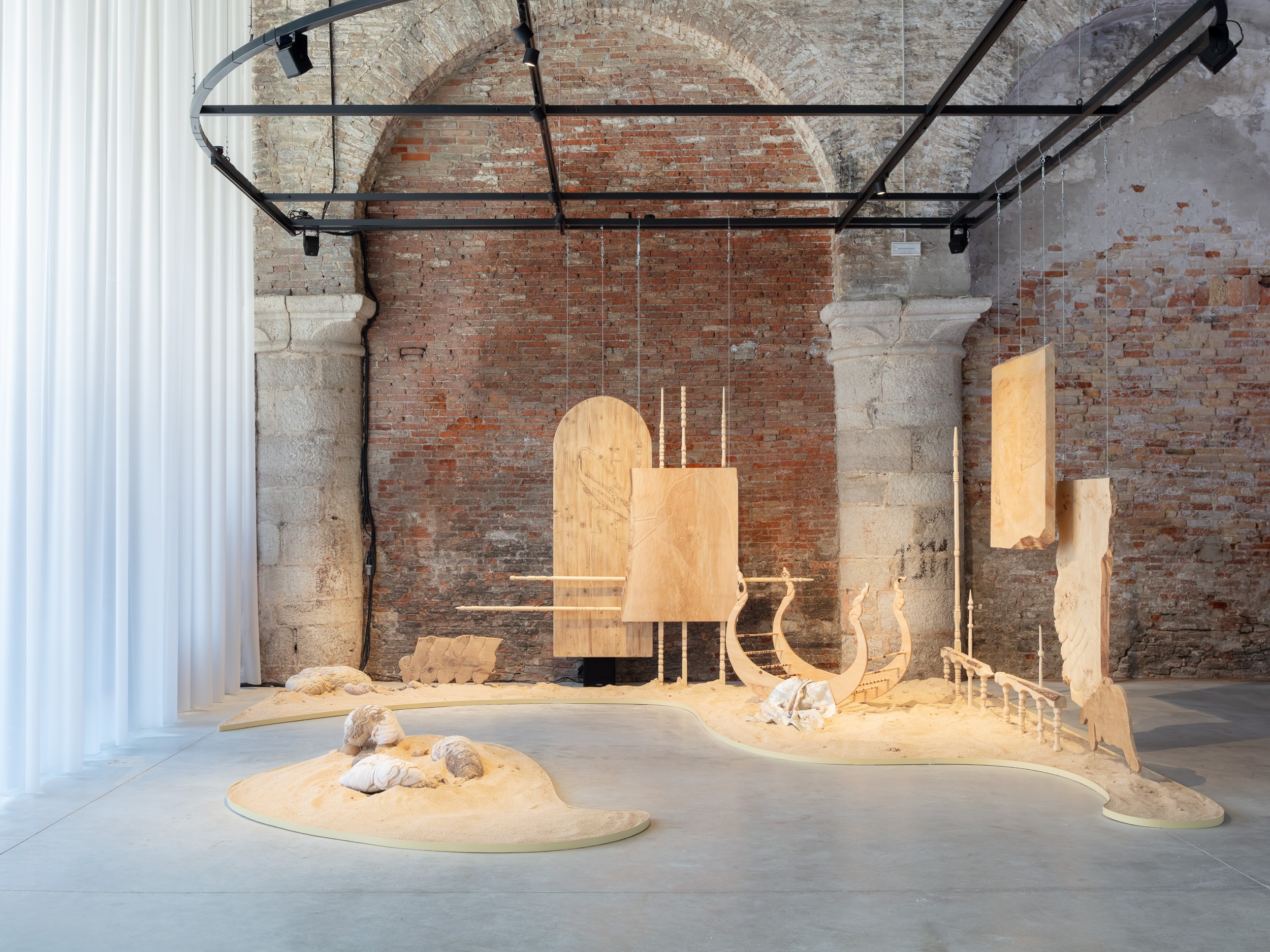
The Uzbekistan Pavilion, housed in the Quarta Tesa of the Arsenale, tackles ecological crisis in a way that is deeply personal to the country, but can speak to everyone. The pavilion conveys beauty and hope while not shying away from destruction.
The Aural Sea
It’s all there the pavilion’s title. “The Aural Sea” is a play on the Aral Sea, one of the great ecological tragedies of our times. You are being asked, before you even enter, to prepare for an alchemy of sorts. The Aral Sea – or rather, the place where the Aral Sea used to be – sits predominantly in the autonomous republic of Karakalpakstan, in Uzbekistan’s northwest. In the 1960s, Soviet irrigation projects redirected the rivers that fed it, and over the following decades, the world’s fourth largest inland lake shrank to a fraction of its former size, leaving behind a salt desert scattered with the rusting hulls of fishing boats.

Stranded boats on the former shoreline of the Aral Sea; image: TCA, Joe Luc Barnes
It is one of the most complete environmental catastrophes of the twentieth century, but the Uzbekistan Pavilion decides to speak about the crisis in an imaginative and almost abstract language. Bringing together perspectives from Central Asia – as well as from even further east – the curators position myths and fiction as alternative systems of knowledge, capable of carrying emotional and ecological memory.
The curatorial framework was developed by the inaugural cohort of the Bukhara Biennial Curatorial School, constituted by Kamila Mukhitdinova, Sophie Mayuko Arni, Nico Sun, Thái Hà and Aziza Izamova. The collective was assembled through Uzbekistan’s Art and Cultural Development Foundation, convened by curator Diana Campbell (who already curated the much-acclaimed Bukhara Biennale) in partnership with the Delfina Foundation.
The exhibition takes its cue from Allayar Darmenov, a young Karakalpak author who began writing about the Aral Sea in 2015, and has created new mythologies around it for contemporary times.
Installation view, The Aural Sea, Uzbekistan National Pavilion, 61st International Art Exhibition – La Biennale di Venezia, 2026. Photo by Gerda Studio. Courtesy of the Uzbekistan Art and Culture Development Foundation.
The Artworks
Coming into the pavilion, the first thing you notice is the sound: a low ambient hum that seems to come from everywhere and nowhere, threading through the space the way memory threads through everyday life. Aura (2025) – a work by Bukhara native Jahongir Bobokulov, whose practice moves between abstraction and vernacular Central Asian architecture – anchors the room with a composition that pulses with inner light.
Using a custom airbrush technique applied to polyurethane foam, Bobokulov creates something that looks like a heat source seen from underwater, or the memory of heat. It is a work about the unseen: emotional residue, the spiritual weight of a landscape that has not finished mattering simply because the water has left.
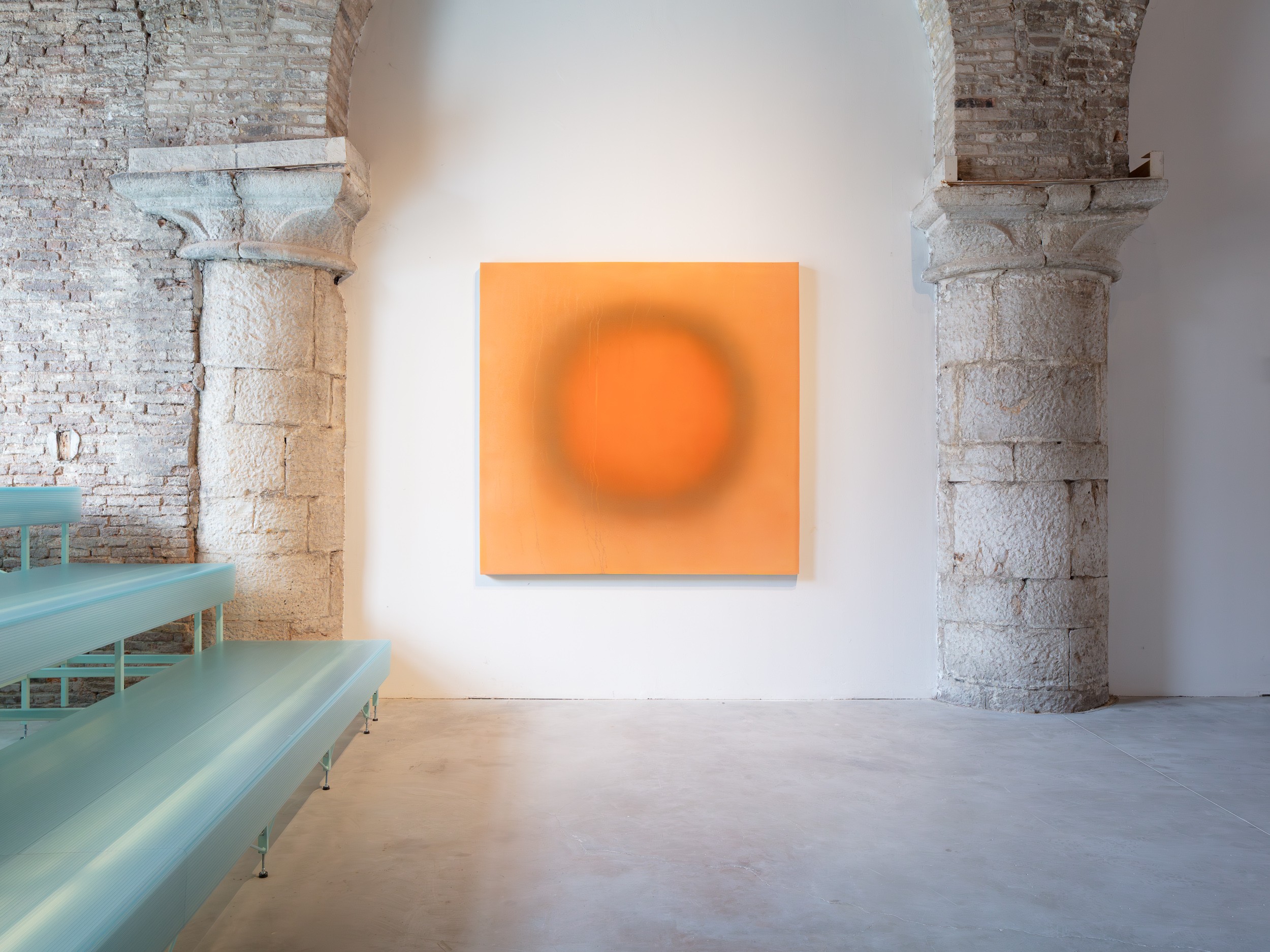
Jahongir Bobokulov, Aura, 2025. Installation view, The Aural Sea, Uzbekistan National Pavilion, 61st International Art Exhibition – La Biennale di Venezia, 2026. Photo by Gerda Studio. Courtesy of the Uzbekistan Art and Culture Development Foundation.
Across the room, the work of Zi Kakhramonova, a multidisciplinary experimental artist and theatre designer from Tashkent, is called “Archive of Lost Forms” (2026) and is a participatory installation. Composed of salt, it invites visitors to recreate lost marine species through physically modelling in salt what no longer exists in water. It involves the sleepy Venice visitor through touch. This is something recurring in Kakhramonova’s practice. She is interested in how tactile, collective gestures can activate cultural memory that official records leave behind.
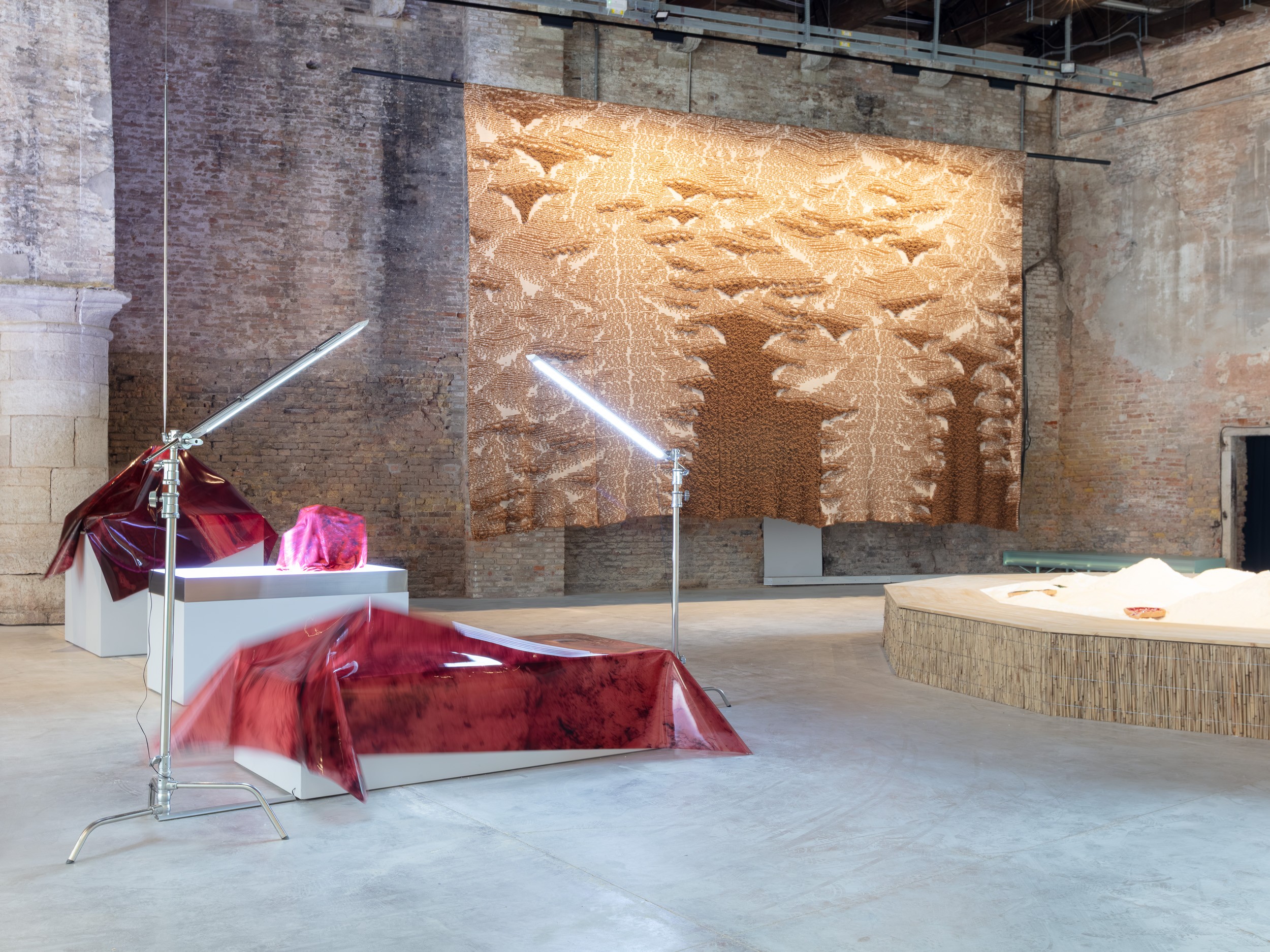
Nearby, A.A. Murakami’s large-scale tapestry “The Sun Sets in a Shell” (2026) draws the eye with its coded surface. The UK and Japan-based duo is known for works that sit at the intersection of natural systems and advanced material technologies, finding new languages for ecological transformation. Working with Mandarin Knitting Technology and Zegna Baruffa Lane Borgosesia, they developed an algorithmic knitting pattern based on the biochemical formation of zebra mussel shells, a species native to the Aral Sea.
The mutations in shell pattern caused by changes in temperature, salinity, acidity and calcium levels mean that each mussel is effectively a recording device, a time capsule of the sea’s chemistry at a particular moment. The tapestry translates this into triangular forms, spirals and waves – it is simultaneously scientific and deeply sensory; the kind of work that rewards looking, the way a text rewards reading.
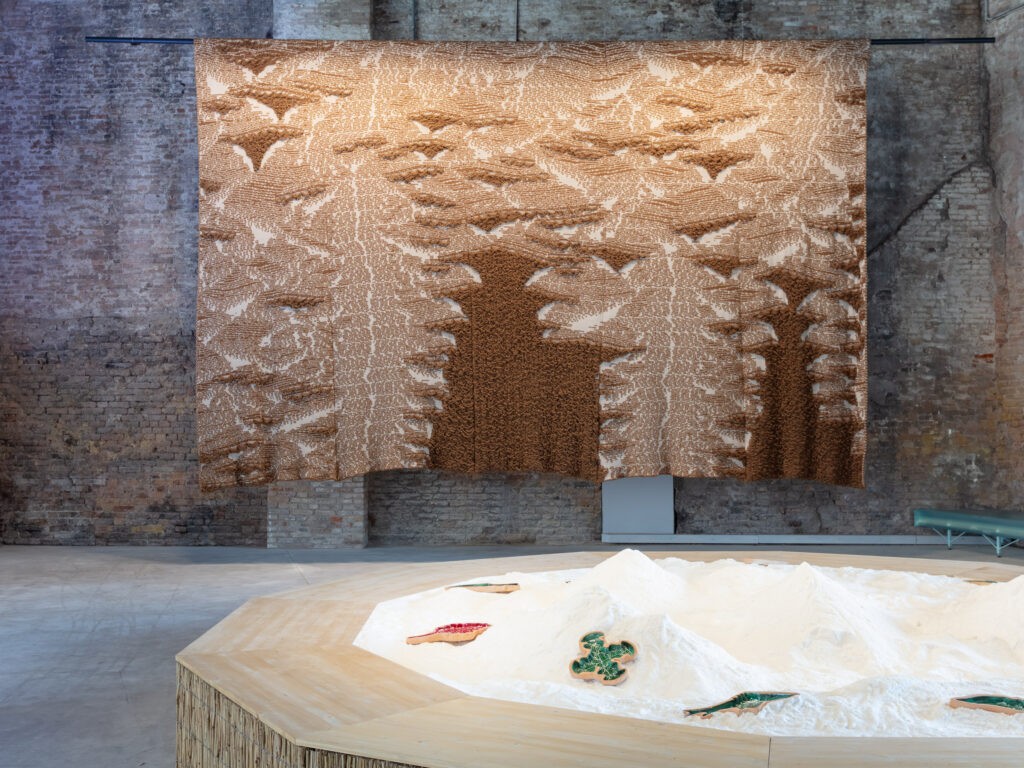
(Background) A.A.Murakami, The Sun Sets in a Shell, 2026. Produced with the support of Mandarin Knitting Technology and Zegna Baruffa Lane Borgosesia. (Foreground) Zi Kakhramonova’s Archive of Lost Forms (2026)
Installation view, The Aural Sea, Uzbekistan National Pavilion, 61st International Art Exhibition – La Biennale di Venezia, 2026. Photo by Gerda Studio. Courtesy of the Uzbekistan Art and Culture Development Foundation.
Chinese artist Xin Liu’s work also proved popular. Her artistic practice spans sculpture, biology and speculative design, often staging encounters between engineered materials and natural processes. Her work “The Permanent and the Insatiable: Born to Sea” (2026) presents two sculptures woven from post-consumer PET bottles and submerged in tanks containing an enzymatic solution. Activated by heat, the solution gradually breaks down the material over the course of the Biennale.
This is a powerful symbol for the Aral Sea’s disappearance, which has left behind rusting Soviet infrastructure from irrigation canals to processing plants.
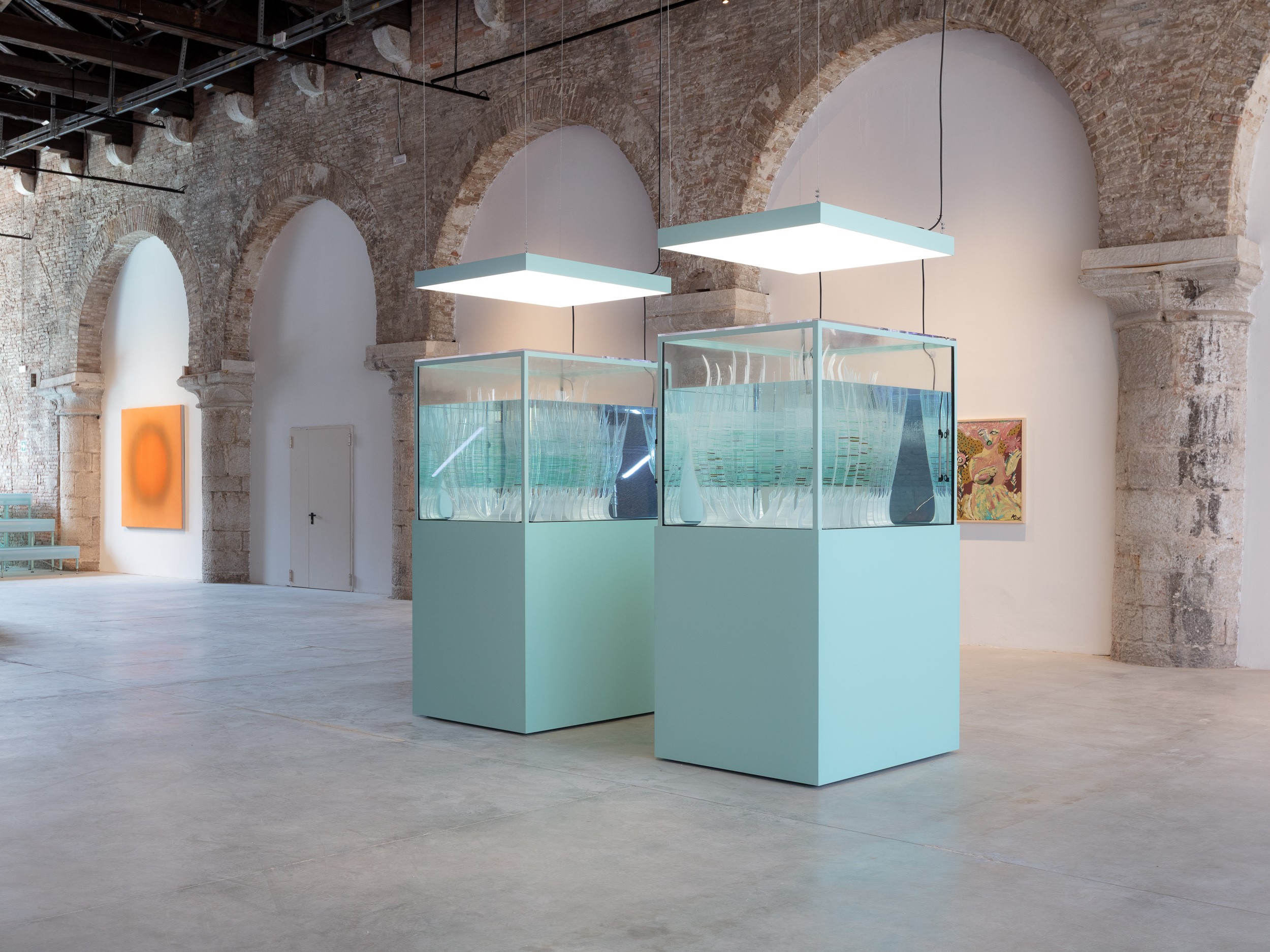
Xin Liu, The Permanent and the Insatiable: Born to Sea, 2026. Installation view, The Aural Sea, Uzbekistan National Pavilion, 61st International Art Exhibition – La Biennale di Venezia, 2026. Photo by Gerda Studio. Courtesy of the Uzbekistan Art and Culture Development Foundation.
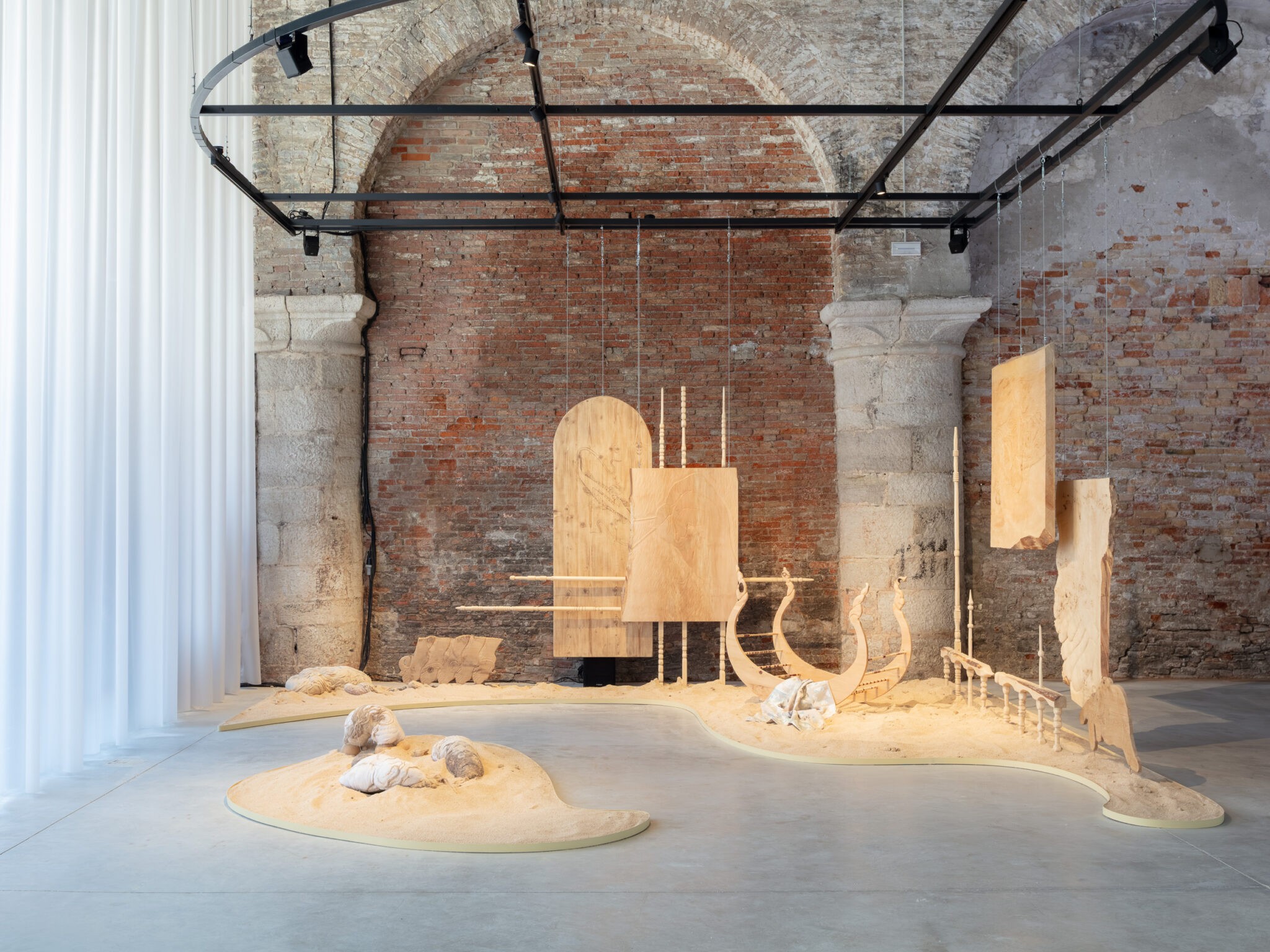
Of a different nature was the work of Zulfiya Spowart, an artist working across sculpture, textile and sound. She draws on the material cultures of Central Asia to explore themes of domesticity, fragility and collective endurance. Her “Beshik (The Cradle)” (2026) is a series of wooden shapes placed in the sand and suspended from the ceiling. Centred on the traditional Central Asian cradle – a wooden structure that functions as a child’s first world – the installation uses wood, textiles, sound and movement to think about fragility and adaptation.
The cradle as a “first home” carries within it both tenderness and the possibility of loss; it is designed for a temporary occupancy, for a being who will outgrow it. In this form, Spowart finds a mirror for the Aral region’s experience: a profound disorientation, a redirection of life toward something not yet mapped.
Zulfiya Spowart, Beshik (The Cradle), 2026. Installation view, The Aural Sea, Uzbekistan National Pavilion, 61st International Art Exhibition – La Biennale di Venezia, 2026. Photo by Gerda Studio. Courtesy of the Uzbekistan Art and Culture Development Foundation.
Aygul Sarsen’s work is much smaller in size. The artist grew up a few hundred kilometers from the former shoreline, but has never seen the water. A painter whose practice is rooted in portraiture as mythological reimagining, Sarsen has long been interested in how inherited landscapes live on in the body even when they can no longer be seen. Her response to this inherited absence is sketched in quick lines and expressive brushstrokes. In his figures, he reimagines the Aral as a feminine deity, – part woman, part bird, part fish, with tree branches for hair. One of her gouache paintings reinterprets a canonical Western work through this lens, replacing the dreaming central figure’s eyes with entirely white orbs, all-seeing and inward, arms marked with crude crosshatching like dried and scored fish skin.
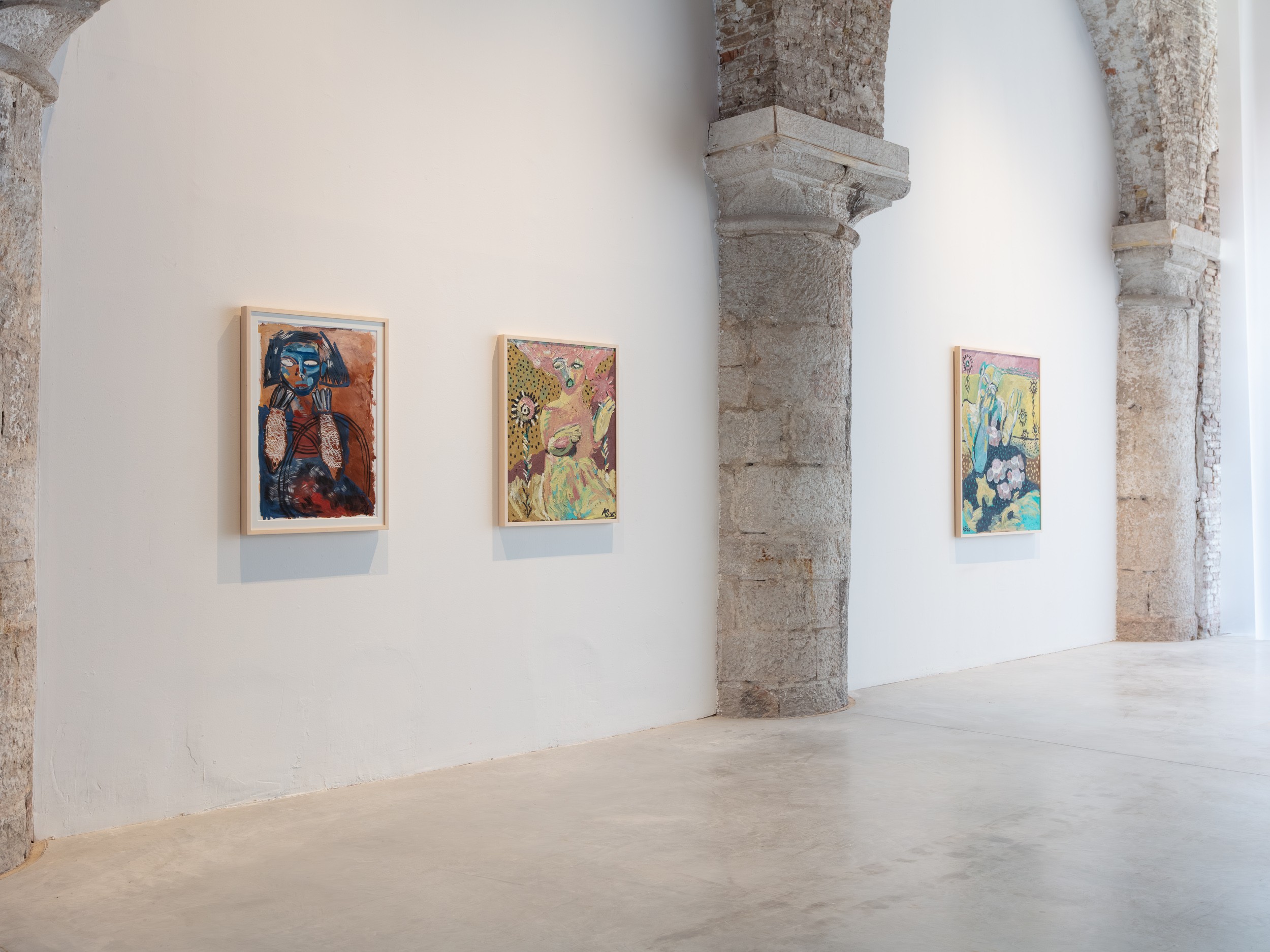
Aygul Sarsen, works from the Brown, Salt, Aral, Amudarya, Muńlı Aral, and Úmitlengen Aral series, 2026. Installation view, The Aural Sea, Uzbekistan National Pavilion, 61st International Art Exhibition – La Biennale di Venezia, 2026. Photo by Gerda Studio. Courtesy of the Uzbekistan Art and Culture Development Foundation.
On the other side of the pavilion, the work of Nguyen Phuong Linh almost evokes the famous artist Christo, known for wrapping objects and monuments in colored sheets. However, the work of this Hanoi-based artist explores the energetic and physical connections between human bodies and geographic landscapes, frequently grounded in extended fieldwork. Her installation Qi tunes into the energetic flows circulating around the seabed, the remnant waters and the atmosphere. Three works with motorized components rise and fall like lungs, expand and contract like hearts.
The color-graded photographs of the Aral landscape are printed on translucent PVC sheets, like skin held up to light. The Aral here becomes a body with interior rhythms, still alive in its transformation, still metabolizing. That is the overall the force of the Uzbekistan Pavilion. It makes the case for imaginative, poetic work, alongside denouncing devastation and destruction. It speaks of ecology “in minor keys,” as Kouoh might have said, but is no less consequential for that.
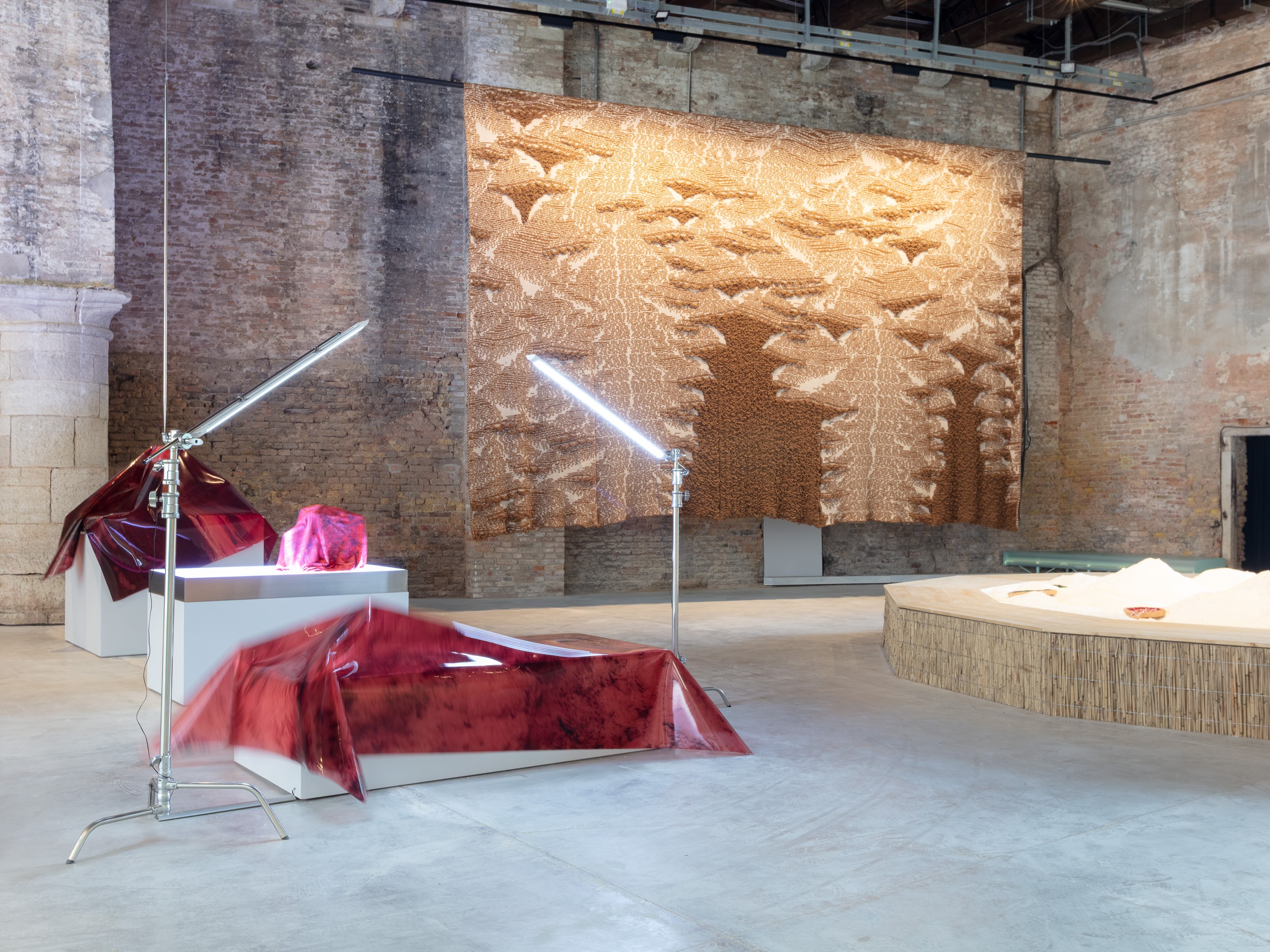
Nguyen Phuong Linh, Qi, 2026. Installation view, The Aural Sea, Uzbekistan National Pavilion, 61st International Art Exhibition – La Biennale di Venezia, 2026. Photo by Gerda Studio. Courtesy of the Uzbekistan Art and Culture Development Foundation.
The Aural Sea is on view at the Uzbekistan National Pavilion, Quarta Tesa, Arsenale, Venice, as part of the 61st International Art Exhibition – La Biennale di Venezia, until 22 November 2026.

yiota
Author’s Posts
-
Iraq’s Oil Lifeline Reopens — But Can Baghdad Trust Turkey for Even One Year?
Aoû 11, 2026
-
Central Asia and Azerbaijan Extend Cooperation Across the Caspian
The Central Asia Times, 11 Augu...
Aoû 11, 2026
-
Ποιοι Είμαστε
της Παναγιώτας Παπαρούνα
Ο μεγάλος ευρασιατικός μας κόσμος!
Της Παναγιώτας Παπαρούνα
Ιράν: Ο Μοτζτάμπα Χαμενεΐ προχώρησε σε αλλαγές κορυφής – Ετοιμάζεται για παρατεταμένη σύγκρουση