ΕΠΙΣΤΗΜΟΝΙΚΑ ΑΡΘΡΑ
Revisiting the Relationship Between Economic and Sea Power

CSIS, Commentary by Benjamin Jensen and Mackenzie Eaglen Published May 22, 2026
The United States is in a maritime crisis brought on by generational neglect of the inseparable relationship between economics and sea power.
While the nation remains a global trading and naval power, the commercial and industrial base that helps convert economic strength into sea power has declined. Shipyards are unable to produce on time, repair capacity is constrained, mariners are scarce, order books are uncertain, and unit costs remain too high to scale. The result is a trap: Weak demand discourages investment, underinvestment keeps capacity (especially in the workforce) low, low capacity raises cost and time, and high cost suppresses demand. The decline of U.S. commercial shipping has created a market failure that produces strategic risk given the growing naval competition between the United States and China.
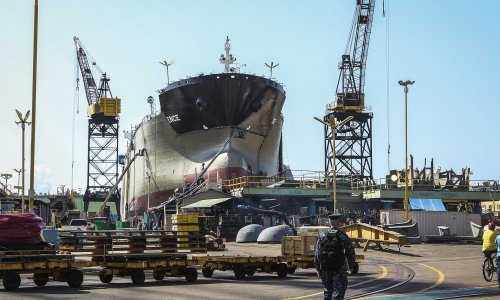
Photo: Chris Goodney/Bloomberg/Getty Images
The United States needs to revisit the core relationship between economic and sea power proposed in the late nineteenth century by Alfred Thayer Mahan. This vision requires building on current White House initiatives to build deeper cross-cutting constituencies that link bipartisan interests in Congress and a mix of U.S. and foreign business initiatives. This network can mobilize the capital, workforce, and manufacturing capacity needed to reconnect economic and sea power and create a novel blueprint for industrial policy that preserves the best of the free market and limited government.
Mahan’s Chain Revisited
Alfred Thayer Mahan’s 1890 Atlantic essay, “The United States Looking Outward,” remains the right conceptual starting point for reconnecting economic and sea power. Mahan argued that production, foreign markets, and the carrying trade (i.e., cargo transportation) formed the “chain of maritime power” behind national wealth and strategic reach. For Mahan, sea power was not just a battle fleet. It was built via the connection between domestic production, external markets, shipping, bases, and the ability to protect movement across oceans.
Today’s maritime chain includes shipyards, dry docks, cranes, port infrastructure, maritime software, fuel logistics, mariners, component suppliers, autonomous systems, financing tools, and allied production networks. The United States does not need to own every ship that carries every cargo. But it does needs enough capacity, redundancy, and control to keep goods moving under the pressure that comes from being a global power with a global naval rival, along with disruptive smaller regional powers or armed groups.
There is coupled relationship between economic systems and sea power. Sea power depends upon a thriving economic foundation and simultaneously creates the conditions needed to enable a strong trade-based economy. Sea power is a state’s capacity to use the sea for military and civilian purposes. Corbettian maritime strategy adds a caution: Naval power has limits and must be integrated with land power, coalitions, and political objectives. In a free market, industrial policy should create incentives and act as a conversion mechanism that turns productive capacity into strategic reach.
President Trump gave the political signal in his March 2025 address to Congress, pledging to resurrect the U.S. shipbuilding industry, including commercial and military shipbuilding, and to create a White House shipbuilding office. Executive Order 14269 then made maritime revival a matter of national policy. The order calls for predictable funding, commercially competitive U.S.-flagged and U.S.-built vessels, a rebuilt maritime industrial base, and a stronger maritime workforce.
The White House’s Maritime Action Plan (MAP) and legislation including the Shipbuilding and Harbor Infrastructure for Prosperity and Security (SHIPS) for America Act offer a way to break that cycle. They are state-led industrial strategy, but their logic should be read through market design. The state helps stimulate demand, financing, workforce pipelines, infrastructure, regulatory certainty, and allied investment channels. Competition would then have to lower shipbuilding costs, improve productivity, expand repair capacity, and make U.S.-flagged vessels more commercially viable on a viciously competitive world market over time.
These industrial policies are designed to address a core dilemma: The United States has only 66 total shipyards, including 8 active shipbuilding yards, 11 yards with build positions, 22 repair yards with drydocking, and 25 topside repair yards. China has over 300 shipyards, and 17 of the 20 busiest repair yards in the world. China’s State Shipbuilding Corporation (CSSC), which absorbed another state-owned firm China Shipbuilding Industry Corporation in 2025, operates 12 top-tier ship yards and the industry is managing four years of orders at full production through 2030. Before its merger, CSSC alone built more tonnage of commercial vessels in just 2024 than the entire U.S. shipbuilding industry since the end of World War II. The consolidation, scope, and scale of China’s shipbuilding is a function of expansive industrial policy and a recognition, by the Chinese Communist Party, of the inseparable nature of economic power and sea power. The result is that China had 5 percent of global shipbuilding in 2000 and more than 50 percent in 2023. The United States currently accounts for 0.1 percent of global shipbuilding. The United States is ranked 19th in the world in commercial shipbuilding and produces 5 ships a year compared to 1,700 made in China.
Though commercial shipbuilding and naval shipbuilding are distinct enterprises, they share an ecosystem of suppliers and workers. Fixing commercial shipbuilding could be a critical lever to help address endemic cost and capacity issues in the long run in the naval shipyards that build the U.S. Navy’s warships.
The United States has a cost and execution problem. The U.S. Navy had not increased fleet size over the last 20 years despite nearly doubling its shipbuilding budget. U.S. acquisition practices repeatedly produced cost growth, delivery delays, and ships that underperformed lofty expectations. The Congressional Budget Office estimated that the Navy’s 2025 shipbuilding plan would cost about $40 billion per year through 2054, in 2024 dollars.
The commercial market presents the same warning. The Cato Institute argues that the United States is nowhere close to becoming a competitive builder of large oceangoing cargo ships under current conditions or plausible subsidy packages. Furthermore, industrial policy can work, but design matters. A 2025 Review of Economic Studies article on China’s shipbuilding policy found that subsidies increased investment, entry, and market share, but also produced low returns, fragmentation, idle capacity, and depressed world ship prices. Organisation for Economic Co-operation and Development research adds that state-owned enterprises account for a significant share of global shipbuilding but tend to operate with lower profitability and higher leverage than private firms.
A laissez-faire approach already failed to produce the maritime capacity U.S. strategy requires. Previous U.S. policies, such as the Construction Differential Subsidy, supported greater numbers of ships being built but did not make the United States competitive on the world stage. Permanent protection, such as the Jones Act, shields shipbuilders from pressure to move down the cost curve. The answer is a competitive industrial strategy: public action to create demand, finance, infrastructure, and workforce capacity, paired with hard performance metrics and contestable awards that are easily competed for by both established builders and new entrants.
MAP and SHIPS as Competitive Industrial Strategy
MAP’s boldest move is to define maritime power as a system. The White House plan connects shipbuilding, repair, ports, cargo preference, workforce, finance, procurement, trade policy, and national security. The plan includes maritime prosperity zones, workforce reform, U.S.-built and U.S.-flagged fleet expansion, deregulation, and a Maritime Security Trust Fund supported in part by port fees.
The SHIPS for America Act is the legislative companion. Its section-by-section summary states that roughly 80 oceangoing ships fly the U.S. flag in international commerce, that the United States lacks industrial capacity to produce oceangoing vessels at scale, and that mariner and shipyard worker demand is growing. The bill seeks national oversight, consistent funding, commercial competitiveness for U.S.-flagged vessels, less red tape, shipyard rebuilding, and stronger workforce recruitment and retention.
The policy logic has five parts:
- create predictable demand through cargo rules, federal procurement, and a Strategic Commercial Fleet;
- provide durable financing through a Maritime Security Trust Fund;
- reduce cost through commercial standards, design discipline, modularity, digital engineering, and scale;
- connect commercial shipping to defense logistics and sea lines of communication; and
- use allied shipbuilders to accelerate learning, import production systems, and create competition inside the U.S. market.
The Way Forward
A new Mahanian moment requires thinking about the relationship between economic and sea power like a modern portfolio manager. The state makes a series of bets that help shape a new market and attract other capital. The objective is to make a series of investments that produce lower-cost hulls, faster repair cycles, deeper supplies networks, and usable sealift for both military and commercial purposes. These investments should act as focal points to support large commercial investments, including foreign direct investment in the U.S. maritime industrial base, and attract new financing from efforts such as the Security and Resilience Initiative. Every dollar should buy both capacity and information: what lowers cost, what speeds delivery, what fails to scale, and which yards can compete. This information in turn should be used to update the portfolio. This requires seven actions:
- Add a statutory cost-down mandate. Congress should require annual reporting on cost per compensated gross ton, construction cycle time, shipyard throughput, repair throughput, workforce productivity, schedule variance, private-capital leverage, supplier diversification, and U.S.-to-allied price parity. MAP already calls for rebuilding capacity at scale. The missing layer is a public scoreboard that tracks whether costs are falling.
- Make the Maritime Security Trust Fund performance gated. Awards should be competed and tied to private capital match, delivery milestones, cost reduction, workforce growth, supplier diversification, and yard modernization. Chronic nonperformance should trigger clawbacks. Strong performance should earn larger order books and faster financing.
- Make the Strategic Commercial Fleet contestable. Fleet entry should be competed by vessel class, route utility, military usefulness, price, delivery schedule, and commercial viability. Studies suggest the Strategic Commercial Fleet can create a consistent demand signal and reduce taxpayer support through competitive bidding. That logic only works if incumbency does not become entitlement.
- Use allied shipbuilders as productivity accelerators. The United States should work with allies and partners to erode China’s market dominance and expand shipbuilding capacity in the United States and key partner countries. Allied investment in the U.S. maritime industrial base should go hand-in-hand with sharing best practices in shipyard production, bringing in advanced technology such as digital yard management tools and robotics, workforce training, supplier localization, and measurable productivity gains. There should be a new arsenal of democracies (plural) that collectively convert economic power into sea power as a foundation of deterrence.
- Sequence cargo preference and China-linked fees with real capacity.MAP financing would rely partly on port fees connected to China-built ships (though fees were paused for one year in November 2025 after diplomatic and trade tensions). Demand creation that outruns capacity can raise costs before it expands supply.
- Enforce design maturity of federal purchases of commercial-grade ships (such as military sealift command vessels) before construction. Shifting designs is a major issue in naval shipbuilding, as the Government Accountability Office’s warning on shipbuilding delays and the Constellation-class frigate showed, and federal adoption of best practices from the commercial sector should become a standing rule for MAP implementation. The United States needs more ships, but immature designs consume yard capacity and compound delay. Congress should also require that these mature designs come with digital twins to support long-term efficiency gains.
- Run an annual stress test on sea lines of communication. The Maritime Administration, the Navy, Transportation Command, the Coast Guard, the Department of Homeland Security, the U.S. Trade Representative, and key allies should assess whether the United States can move military cargo, sustain critical imports, repair damaged vessels, crew ships, and keep priority ports open during crisis. The output should include a classified readiness assessment and an unclassified scorecard that can support government programs, legislation, and efforts to align commercial interests.
Conclusion
Efforts such as MAP and SHIPS can rebuild maritime power if they create a competitive marketplace that connects economic and sea power. State action is now required because the existing market does not generate enough U.S. maritime capacity for national strategy. That action should force competition, not shelter inefficiency.
Mahan’s chain still holds: Production, markets, shipping, and maritime security are connected. The modern chain runs through yards, ports, mariners, finance, software, repair capacity, autonomous systems, allied production, and commercial fleets. The strategic objective is a maritime market that lowers shipbuilding costs over time, expands U.S.-flagged and allied capacity, strengthens wartime logistics, and secures the sea lines of communication that sustain U.S. economic power.
Benjamin Jensen is director of the Futures Lab and a senior fellow for the Defense and Security Department at the Center for Strategic and International Studies (CSIS) in Washington, D.C. Mackenzie Eaglen is a senior fellow at the American Enterprise Institute (AEI), where she works on defense strategy, defense budgets, and military readiness.

yiota
Author’s Posts
-
Iraq’s Oil Lifeline Reopens — But Can Baghdad Trust Turkey for Even One Year?
Aug 11, 2026
-
Central Asia and Azerbaijan Extend Cooperation Across the Caspian
The Central Asia Times, 11 Augu...
Aug 11, 2026
-
Ποιοι Είμαστε
της Παναγιώτας Παπαρούνα
Ο μεγάλος ευρασιατικός μας κόσμος!
Της Παναγιώτας Παπαρούνα
Ιράν: Ο Μοτζτάμπα Χαμενεΐ προχώρησε σε αλλαγές κορυφής – Ετοιμάζεται για παρατεταμένη σύγκρουση